
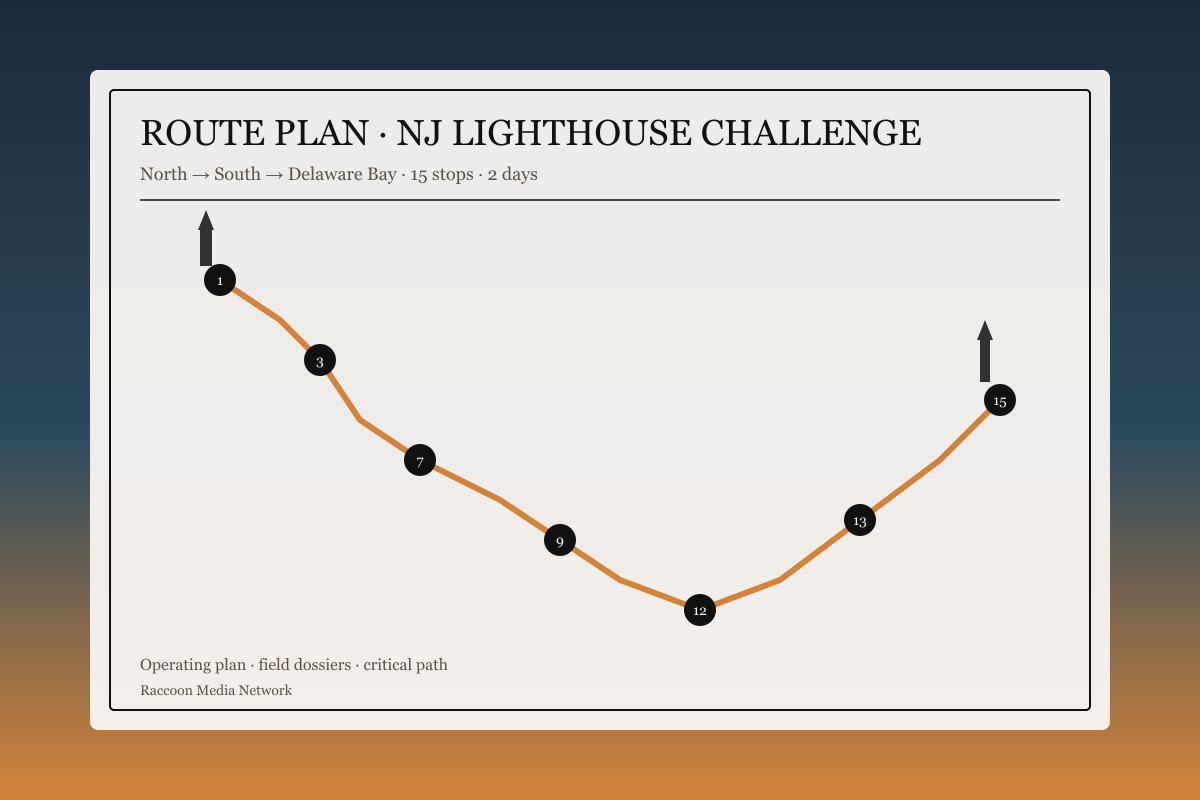
In the advance article, I called the Lighthouse Challenge of New Jersey a two-day maritime road trip. That description was true but it was also incomplete.
The moment you stop looking at the map as a collection of pretty towers and start asking how to actually visit every site between Sandy Hook and Paulsboro inside one October weekend, the event changes categories. It becomes project management with Fresnel lenses.
There are fixed operating windows. There are dependencies. There are geographic bottlenecks. There is one long out-and-back to the north end of Long Beach Island, another long rural transfer across Cumberland and Salem counties, multiple island causeways, potential tower lines, weather-sensitive climbs, a souvenir that must survive two days of getting in and out of a car, and a hard final deadline of 6 p.m. Sunday.
That does not make the Challenge less romantic, it just makes the romance easier to preserve. A good plan is what creates enough margin to stand at the top of a lighthouse for a minute without mentally calculating whether traffic on Route 72 has just killed Sunday afternoon. This page is print-ready for the glove box.
The Assignment
The 2026 Lighthouse Challenge takes place Saturday and Sunday, October 17 and 18. The official Challenge runs from 8 a.m. to 6 p.m. both days. The organizer lists 11 lighthouse sites, four lifesaving stations and one museum. That is 16 Challenge sites but only 15 physical stops because East Point also hosts the Delaware Bay Lights component. Registration is $10, there is no pre-registration, and participants can begin at any Challenge site. Climbing is not required for completion.
For 2026, the official site lists three Saturday night-climb locations open from 6 to 8 p.m.: Twin Lights, Tucker's Island Light at Tuckerton Seaport and Tinicum Rear Range Light. The organizer specifically advises arriving by 7:30 p.m. at the latest if a night climb is the goal.
The 2026 souvenir system is also part of the operating model. The Challenge FAQ says registrants receive a 16-month calendar with full-color images of the sites and collect a small stamp at each location. Finish the full route and the final site verifies the set, adds a completion sticker and enters the finisher into a prize drawing.
There are really two versions of this weekend. The first is the completion challenge: visit every site, collect every stamp, see enough of each location to understand what it is, and finish inside the window. The second is the deep-history tour: climb every open tower, read every exhibit, walk every trail, take the scenic side road, eat a real lunch and stop whenever something interesting appears. Those are both excellent weekends. They are not the same weekend. If completion matters, the rule should be simple: the route is mandatory; climbs and side attractions are conditional.
Field Guide
- The Assignment
- Recommended sequence
- Day 1 schedule
- Day 2 schedule
- The Critical Path
- Field Protocol
- What to climb
- Attractions A / B / C
- Risk Register
- Stop index
- Quick reference
Recommended Sequence
For a participant beginning in North or Central Jersey, the cleanest route is a clockwise sweep: start at Sandy Hook, run the Atlantic coast south through Tuckerton and Atlantic City, continue through Cape May, then turn northwest along the Delaware Bay and finish on the Delaware River at Tinicum in Paulsboro.
This is not about finding the mathematically shortest line between every coordinate. New Jersey's barrier islands, bridges and limited access roads make that kind of optimization misleading. The useful unit is backtracking. The proposed route minimizes meaningful reversals and keeps the two worst geographic obligations,Long Beach Island and the Delaware Bay transfer, moving in the same overall direction.
Using the Challenge organization's published inter-site driving estimates as a base, the route is roughly 300 to 320 miles between Challenge stops before hotel, fuel, food and any sightseeing deviations. Live traffic will move that number and the clock. The weekend cannot be managed as 15 independent visits. It must be managed as one continuous chain.
- Sandy Hook Lighthouse — Fort Hancock — Sandy Hook
- Spermaceti Cove U.S. Life-Saving Station No. 2 — Sandy Hook
- Navesink Twin Lights — Highlands
- Sea Girt Lighthouse — Sea Girt
- Squan Beach Life Saving Station — Manasquan
- Barnegat Light Museum — Barnegat Light
- Barnegat Lighthouse — Barnegat Light
- Tucker's Island Light at Tuckerton Seaport — Tuckerton
- Absecon Lighthouse — Atlantic City
- U.S. Life-Saving Station 30 — Ocean City
- Tatham Life Saving Station — Stone Harbor
- Cape May Lighthouse — Cape May Point
- East Point Lighthouse + Delaware Bay Lights — Maurice River area
- Finns Point Rear Range Light — Pennsville
- Tinicum Rear Range Light — Paulsboro
Day 1: Own the North Shore and Long Beach Island
Open Day 1 in Google Maps — stops 1 through 8 in recommended order.
| Target | Stop | Management note |
|---|---|---|
| 7:35–7:50 a.m. | Stage at Sandy Hook | Park, restroom, organize route packet. Do not spend opening minutes looking for registration materials. |
| 8:00–8:25 | Sandy Hook Lighthouse | Register here if convenient. Tour grounds; climb only if line and tower access fit the plan. |
| 8:30–8:55 | Spermaceti Cove | Second Sandy Hook stop. Keep the park segment together before leaving the peninsula. |
| 9:10–9:45 | Twin Lights | High-value history stop. A quick tower climb is reasonable if there is no line. |
| 10:40–11:05 | Sea Girt Lighthouse | Compact site. Treat as a disciplined 20–25 minute stop. |
| 11:15–11:40 | Squan Beach Station | Short transfer from Sea Girt. Good place to recover a few minutes. |
| 12:50–1:15 p.m. | Barnegat Light Museum | Do the museum first; it contains the lighthouse's original first-order Fresnel lens. |
| 1:20–1:50 | Barnegat Lighthouse | Climb only if schedule is healthy. The 217 steps can quietly turn a 20-minute stop into 40. |
| 2:30–3:15 | Tuckerton Seaport | The most substantial "site" on Day 1. Give it more room if you have earned the time. |
| 3:15 decision gate | Choose the Saturday finish | If you are running 45–60 minutes ahead, continue to Absecon before 6. If not, keep Tuckerton as the safe finish and use its 6–8 p.m. night-climb window if desired. |
| Evening | Overnight in Atlantic City / Galloway corridor | Position the car so Sunday begins at Absecon without a long deadhead drive. |
The crucial piece is the Tuckerton gate. The official 2026 night-climb schedule turns Tuckerton into a built-in buffer. If Long Beach Island traffic or a tower line consumes the afternoon, Tuckerton can absorb the delay without forcing a reckless sprint to Atlantic City. If the day runs cleanly, visit Tuckerton in the afternoon and take Absecon off Sunday's board.
Day 2: South Jersey, the Bay, and the Final Run Up the Delaware
Open Day 2 in Google Maps — stops 9 through 15 in recommended order.
| Target | Stop | Management note |
|---|---|---|
| 7:45 a.m. | Stage at Absecon | If Absecon was completed Saturday, use this buffer to start Ocean City early or sleep like a civilized person. |
| 8:00–8:40 | Absecon Lighthouse | One of the climbs worth budgeting for: 228 visitor steps and the original first-order Fresnel lens still at the top. |
| 9:20–9:45 | U.S. Life-Saving Station 30 | Ocean City stop; historically dense, physically compact. |
| 10:25–10:50 | Tatham Station | Stone Harbor. Keep this one efficient unless the tower is a priority. |
| 11:25–12:10 | Cape May Lighthouse | Second major climb candidate. The setting is part of the visit, so give this stop real time. |
| 1:05–1:35 | East Point / Delaware Bay Lights | One physical stop, two Challenge site credits. Verify the organizer's final 2026 stop address shortly before the event. |
| 2:45–3:10 | Finns Point Rear Range | The longest Sunday inter-site leg ends at a rare open-frame range light in a national wildlife refuge. |
| 3:40–4:15 | Tinicum Rear Range | Finish here. Confirm completion before leaving. The remaining time is your contingency reserve, not an invitation to schedule more required work. |
| After completion | Anything else | Now the attractions can win. |
The Sunday plan deliberately finishes before 6. That gap is not wasted time. It is schedule reserve. Project plans fail when every minute is assigned before reality arrives.
The Critical Path
1. Sandy Hook is a one-road peninsula. Sandy Hook gives the weekend two official stops in one geographic cluster, which is efficient, but the peninsula has a single main road and the Lighthouse sits at Fort Hancock near the north end. Do both stops together. Leaving the Hook and later returning would be the kind of route mistake that becomes family folklore for all the wrong reasons.
2. Long Beach Island is the day-one bottleneck. The Barnegat sites are geographically close to each other but expensive to reach. The Challenge directions put Squan Beach to Barnegat Light at roughly 51 miles and about 70 minutes, then require the same north-end-of-LBI road network to get back to Route 72. That out-and-back is unavoidable. Bundle the museum and lighthouse, fuel before the island if necessary, and do not schedule lunch that requires table service during this segment.
3. The East Point-to-Finns Point transfer is the quiet monster. The most deceptive leg is not on the Parkway. It is the rural cross-state move after East Point. The Challenge's published directions estimate roughly 50 miles and more than an hour to Finns Point. There are fewer obvious recovery options if you lose time here. Sunday's early stops must protect this transfer.
4. Night climbs are contingency tools first, attractions second. Twin Lights, Tucker's Island and Tinicum are the 2026 Saturday night-climb sites. For the recommended north-to-south route, Tucker's Island is the operationally useful one because it sits near the natural Saturday stopping zone. Twin Lights is too early to help unless you deliberately start elsewhere. Tinicum is at the far western end of the route and only helps a south-to-north Saturday strategy. Use the night window to extend the critical path, not to create a backtrack for the sake of darkness.
Field Protocol
Friday-night setup. Fuel the vehicle. Download offline maps and save the 15 locations individually. Print the Challenge route and carry a paper copy of the addresses. Pack water, portable food, charging cables, a battery bank, rain gear and a small rigid folder or envelope for the Challenge calendar/stamps. Check the weather at both ends of the state. Choose the priority climbs before leaving home.
Assign roles. If more than one adult is in the car, one person drives. One person navigates, watches the next address, manages the stamp holder, checks opening information and handles the decision gates. Switch roles if needed, but make ownership explicit.
Use a 20-minute default dwell. A 20-minute site budget is enough to park, register or stamp, see the primary artifact, take photographs and understand where you are. Larger sites — Absecon, Cape May, Twin Lights and Tuckerton — deserve more. Compact lifesaving stations can return some of that time.
The climb rule. Climbing is not required. Create a line threshold: if a non-priority tower has more than roughly a 15-minute wait, move on. A single climb is not worth sacrificing a site that cannot be revisited after 6 p.m. Sunday.
The 30-minute trigger. If the route falls 30 minutes behind plan, the next scenic side stop disappears. If it falls 45 minutes behind, non-priority climbs disappear. If it falls an hour behind before Tuckerton on Saturday, activate the Tuckerton night-climb buffer and move Absecon to Sunday.
What to Climb If You Cannot Climb Everything
If the weekend goal is both completion and a representative vertical experience, choose climbs by difference rather than by quantity:
- Sandy Hook or Twin Lights for the northern historical story. Sandy Hook wins on age; Twin Lights wins on technological range and elevation.
- Barnegat if Old Barney is personally important, but only if the LBI schedule is clean.
- Absecon because 228 steps, the original first-order Fresnel lens and the Atlantic City skyline make it a materially different climb.
- Cape May because the lighthouse, state park, ocean and Delaware Bay meet in one place.
- One Delaware River range light — preferably Tinicum if time and access allow — because climbing a skeletal range tower is structurally and visually different from a masonry coastal lighthouse.
Attractions Worth Knowing About
Category A — already inside the Challenge stop: Fort Hancock context at Sandy Hook; Twin Lights museum; Barnegat Lighthouse State Park and inlet views; Tuckerton Seaport; Cape May Point State Park; Supawna Meadows around Finns Point. A few extra minutes deepen the visit without a separate navigation event.
Category B — micro-detours only if the schedule is green: Mount Mitchill Scenic Overlook near Highlands; Manasquan Inlet after Squan Beach; Atlantic City Boardwalk near Absecon only after Absecon is complete and the day is over; Stone Harbor waterfront only if clearly ahead.
Category C — build a separate return trip: Fort Hancock batteries in depth; Tuckerton Seaport as a half-day museum visit; Cape May historic district, Sunset Beach and WWII sites; Fort Mott State Park; Red Bank Battlefield and Whitall House; Maurice River / Delaware Bayshore birding. The Challenge is valuable partly because it identifies the places worth coming back to.
Risk Register
| Risk | Likelihood | Where it hits | Control |
|---|---|---|---|
| Traffic / bridge delay | High | Sandy Hook access, Route 72/LBI, Atlantic City, island causeways | Carry 60–90 minutes of Sunday buffer; avoid unnecessary backtracking. |
| Tower line | Medium | Sandy Hook, Barnegat, Absecon, Cape May | Use preselected priority climbs and a 15-minute line threshold. |
| Weather / wind | Medium–High | All towers; especially exposed coastal and skeletal lights | Remember climbs are optional. Check site notices before departure. |
| Wrong Challenge address | Medium | East Point / Delaware Bay combined stop | Verify organizer's final 2026 location during event week. |
| Food stop expands | Medium | Anywhere after noon Saturday | Pack food. Treat sit-down meals as post-route rewards. |
| Navigation / phone failure | Low, high impact | Rural Cumberland/Salem legs | Offline maps + printed addresses. |
| Souvenir/stamp damage or loss | Low, catastrophic to the fun | All weekend | Use a rigid folder; one person owns it. |
| Over-climbing / fatigue | Medium | Second half of both days | Hydrate, choose climbs, do not turn completion into a stair contest. |
| "We have time" optimism | Guaranteed | Every scenic town in New Jersey | Decision gates exist because optimism is not a schedule. |
Stop Index
Full field dossiers for each physical stop live on their own pages. Use this index for the glove-box overview; open a stop page when you need history, climb notes and nearby temptations.
| # | Name | Type | Town | Default dwell | Climb note |
|---|---|---|---|---|---|
| 1 | Sandy Hook Lighthouse — Fort Hancock | Lighthouse site | Sandy Hook | 25 min | Conditional |
| 2 | Spermaceti Cove U.S. Life-Saving Station No. 2 | Lifesaving station | Sandy Hook | 25 min | Watchtower if open |
| 3 | Navesink Twin Lights | Lighthouse site | Highlands | 35 min | High value if no line |
| 4 | Sea Girt Lighthouse | Lighthouse site | Sea Girt | 20–25 min | Quick stop |
| 5 | Squan Beach Life Saving Station | Lifesaving station | Manasquan | 20–25 min | Short transfer from Sea Girt |
| 6 | Barnegat Light Museum | Museum site | Barnegat Light | 25 min | Museum first, then lighthouse |
| 7 | Barnegat Lighthouse | Lighthouse site | Barnegat Light | 30 min | Priority climb only if LBI is clean |
| 8 | Tucker's Island Light at Tuckerton Seaport | Lighthouse site | Tuckerton | 45 min | Saturday decision gate |
| 9 | Absecon Lighthouse | Lighthouse site | Atlantic City | 40 min | Priority climb |
| 10 | U.S. Life-Saving Station 30 | Lifesaving station | Ocean City | 20 min | Compact history stop |
| 11 | Tatham Life Saving Station | Lifesaving station | Stone Harbor | 20–25 min | Keep efficient |
| 12 | Cape May Lighthouse | Lighthouse site | Cape May Point | 45 min | Priority climb |
| 13 | East Point Lighthouse + Delaware Bay Lights | Two lighthouse sites / one stop | Maurice River area | 30 min | Verify 2026 stamp address |
| 14 | Finns Point Rear Range Light | Lighthouse site (range light) | Pennsville | 25 min | Sunday ~3 p.m. checkpoint |
| 15 | Tinicum Rear Range Light | Lighthouse site (range light) | Paulsboro | 35 min | Finish / completion closeout |
The Route Is the Story
The Lighthouse Challenge is not really a scavenger hunt for towers. It is a compressed map of how New Jersey met the ocean. The northern sites explain New York Harbor. The Shore sites explain coastal navigation and rescue. The lifesaving stations explain the human response when ships still found the beach. Cape May turns the route from Atlantic Ocean to Delaware Bay. The range lights explain the last industrial problem: how to take a vessel from open water into a river channel and keep it there.
Project management sounds like the least romantic way to approach any of that. In practice, it is the reason you get to notice it. A route that works means nobody is yelling directions at 5:42 Sunday afternoon. A time buffer means Cape May can have ten extra minutes because the light is good. A predetermined climb strategy means a child can stop on the stairs without the entire weekend collapsing.
The advance called it a maritime road trip. This follow-up is the operating plan. Now somebody has to drive it.
Quick Reference: 2026 Challenge Facts
| Dates | Saturday–Sunday, October 17–18, 2026 |
|---|---|
| Regular site hours | 8:00 a.m.–6:00 p.m. both days |
| Saturday night climbs | Twin Lights, Tucker's Island Light, Tinicum Rear Range Light; 6:00–8:00 p.m.; arrive by 7:30 for a climb |
| Challenge size | 11 lighthouse sites + 4 lifesaving stations + 1 museum = 16 sites / 15 physical stops |
| Registration | $10; no pre-registration; begin at any Challenge site |
| Climbing | Not required for Challenge completion; some towers charge separate climb fees |
| 2026 souvenir | 16-month calendar with site images; collect thumbnail stamps at each site |
| Completion | Final site verifies stamps, provides completion sticker and enters finisher in prize drawing |
| Best north-to-south overnight zone | Atlantic City / Galloway corridor after Tuckerton or Absecon |
| Most important route check | Confirm the final 2026 East Point / Delaware Bay Lights Challenge address before event weekend |
Event Details
| What | Lighthouse Challenge of New Jersey |
|---|---|
| When | Saturday, Oct. 17 and Sunday, Oct. 18, 2026; sites open 8 a.m.–6 p.m.; Saturday night climbs 6–8 p.m. at three sites |
| Where | 11 lighthouse sites, four lifesaving stations and one museum from Sandy Hook to Cape May and along the Delaware Bay/River |
| Registration | $10 registration fee for souvenir collection |
| Also | Night climbs at Twin Lights, Tucker's Island Light at Tuckerton Seaport, and Tinicum Rear Range Light; check site-specific climbing and admission policies; verify East Point / Delaware Bay stop address during event week |
| Calendar | Add event to calendar |
SOURCE NOTES
• Lighthouse Challenge of New Jersey — 2026 home
• Lighthouse Challenge — FAQ / map / Challenge sites / Hours & Directions
• VisitNJ — Lighthouse Challenge Weekend
• NPS — Sandy Hook Lighthouse
• NJDEP — Twin Lights
• Absecon Lighthouse
• Cape May MAC — Cape May Lighthouse
• USFWS — Supawna Meadows / Finns Point
This follow-up prioritizes the Lighthouse Challenge of New Jersey's official 2026 pages for dates, site count, registration rules, souvenirs and night climbs; federal and state historic-site agencies for preservation and operational history; and the individual nonprofit/site organizations for building-specific information. The Challenge organization's printable route directions currently surfaced in an "updated for 2025" PDF and are used here only for inter-site distance/time planning. The official 2026 Hours & Directions page supersedes older night-climb references in that PDF. Live travel times and the East Point / Delaware Bay stamp address should be checked during event week.